Journal
Blepharoplasty vs ptosis repair vs brow lift: a decision map
Three operations can open heavy looking eyes, but they fix different causes. A plain decision map for skin, lid muscle and brow position.
 Rebecca Wetherby
“Eyelid surgery” is often used for three different operations. One removes skin, one tightens the lifting muscle, and one raises the brow. The right one depends on what is pressing the eye down.
Choosing by name is how people end up asking for the wrong thing. This map starts from the cause you can see, then points to the operation that addresses it.
What are the three causes of a heavy looking eye?
Think of the upper eye as a stack. The brow sits on top, the skin and fat fold below it, and the lid edge opens or closes over the eye, lifted by a muscle.
A heavy look can come from any layer. Extra skin hangs over the lid, the brow sits low and pushes down, or the lid edge itself rides low because the muscle opens less.
I used one model. The baseline is her front photo with a relaxed face. The simulation below moves only the brow layer, so you can see what that layer does by itself.
How do the three operations compare?
Here is the map in a table. Read across the row that matches what you notice in the mirror.
| What you notice | Likely layer | Operation to ask about |
|---|---|---|
| Skin hangs over the lashes, crease hidden | Excess lid skin | Blepharoplasty |
| Lid edge covers part of the iris, even without extra skin | Lifting muscle | Ptosis repair |
| Brow sits low, tail drops, forehead works hard | Brow position | Brow lift |
| A mix of the above | More than one layer | A combined plan, decided in person |
Many people have a mix, and a surgeon may suggest a combination. The point of the table is to ask a sharper question, not to self diagnose.
What does a lower brow do to the eye?
The brow is the easiest layer to mistake for a lid problem. When it sits low, it presses the upper lid skin down and shortens the visible lid space.
A simple mirror test helps. With your face relaxed, gently hold your brow in its lifted position with a fingertip and look again. If the eye opens and the fold eases, the brow may be a main factor.
In the simulation below, the brows are raised, mainly toward the outer ends, and nothing else moves. The change is clear at a glance: the brows sit visibly higher, especially toward the outer ends, and the space between brow and lashes opens up.
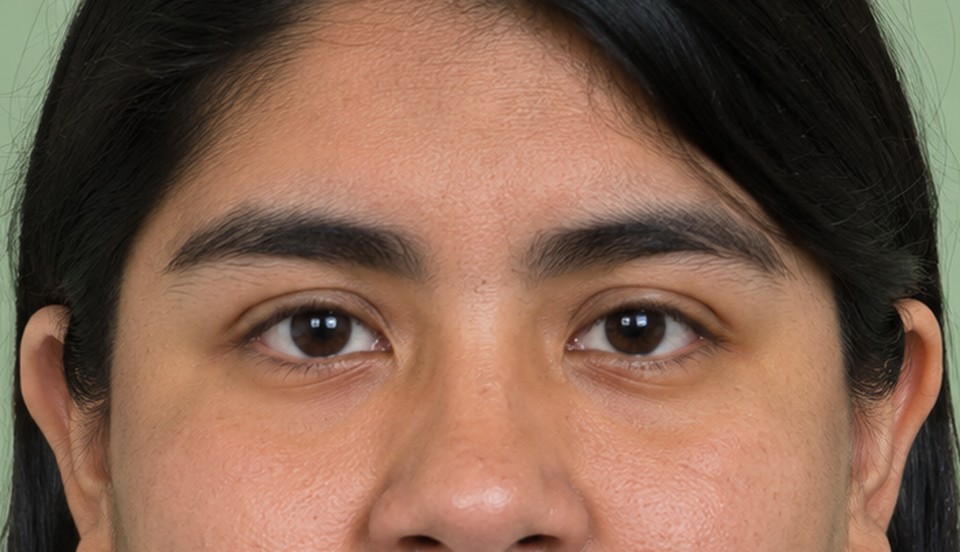
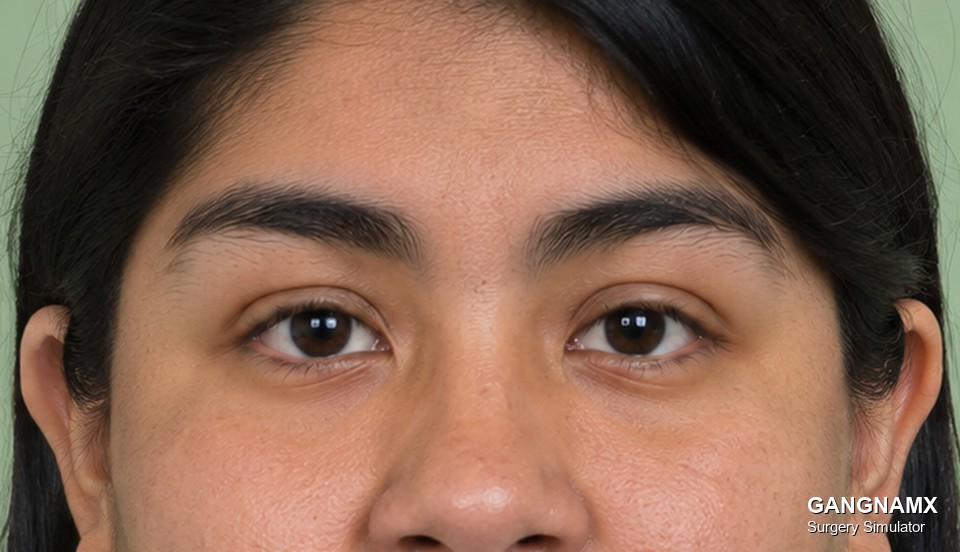
This is a clear change, and the whole upper face reads more open. A brow lift is also a larger operation than the others, so it is usually kept for cases where the brow is clearly the main driver.
What does lid opening look like by itself?
Ptosis is the medical word for a lid edge that sits lower than normal. The upper lid covers more of the iris than it should, and the eye can look sleepy or smaller.
This is a muscle and tendon question, not a skin question. It can be present from birth, appear slowly with age, or follow wearing contact lenses for years. Any sudden change should be checked by a doctor first.
On a photo, look at how much of the iris the upper lid covers. A lid edge that sits lower hides more of it, and a lifted edge shows more, while skin and brow stay where they were.
What does removing lid skin do?
Blepharoplasty trims excess skin and sometimes a little fat or muscle from the upper lid. It tidies the fold and can make the crease easier to see.
On a lid that is already fairly open, the visible gain is modest. The eye shape, brow and lash line stay in place, so the face keeps its identity. Our model’s lids are not heavy to begin with, so I did not simulate this one.
The difference to look for is in the fold, not in how open the eye is. That is the cleanest way to tell blepharoplasty from ptosis repair on a picture.
Can you combine the three?
Yes, and surgeons often do. A person with a low brow and extra skin may be offered a modest brow lift with an upper lid skin tidy. A person with a low lid edge and excess skin may need both lid work and skin removal.
The order of planning matters. Removing skin first on a lid that really needs ptosis repair can leave the eye still looking tired. Lifting the brow first can reveal that the lid skin was never the problem.
That is why a good consultation looks at the brow, the skin and the lid edge together. A surgeon who only looks at the skin may miss the cause.
What are the limits of this map?
A picture cannot measure the lifting muscle, check how the eye closes or test your eyes for dryness. Those are part of an examination, and they decide which operation is safe for you.
The simulation also moves one layer at a time, while a real face moves as a whole. A brow lift changes the lid skin a little, and lid surgery changes how the brow sits. Treat the brow simulation as a thought experiment about one layer.
Finally, recovery differs. Skin removal usually has the shortest recovery of the three, while a brow lift is more involved. Ask your surgeon what each option means for your time and your risk.
What should you bring to a consultation?
The map gives you the questions, and a surgeon gives you the answer after an examination. Treat the simulation as a way to point at what you mean.
- Is my heavy look mainly skin, the brow, or the lid edge?
- Would one operation be enough, or do these layers need to be combined?
- How would my eyes keep looking like mine afterwards?
- Is anything about my lid position a health matter that should be checked first?
A droop that appears suddenly, or comes with double vision, pain or weakness, needs a doctor before any cosmetic plan.
If you want to see which layer matters on your own face, preview one change at a time and compare. The result will not be a promise, but it makes your questions sharper.
Simulation images by GangnamX.